

EQF Timber
Significance of qualifications frameworks
Qualifications frameworks are documents that systematically bring together school, vocational and academic qualifications within an education system. Within these frameworks, qualifications are assigned to different levels, which represent the level of attainment.
In the field of vocational training, aptitudes and competences form the basis of qualifications. These apply equally to individuals who can demonstrate relevant learning outcomes and certificates obtained through formal vocational training, or who have acquired them through non-formal or informal means whilst working in a company without formal vocational training.
Qualifications demonstrated on a case-by-case basis reveal a personal competence profile, which provides individuals with evidence of the specialist knowledge they possess, the skills they are able to perform, or the extent to which they are capable of implementing assigned tasks independently and competently.
Qualifications frameworks with different functions
Existing qualifications frameworks, such as the general European Qualifications Framework (EQF) and country-specific National Qualifications Frameworks (NQFs), have a geographical dimension of particular functional significance. The European Qualifications Framework for Timber Construction (EQF-Timber), in addition to its spatial reference, already has a direct technical link to the timber construction sector and, in its digital form, offers extensive capabilities as a validation and development tool. The three qualifications frameworks are outlined in detail below.
The European Qualifications Framework (EQF)
is a descriptive framework in which professional qualifications are assigned to eight progressive levels of competence based on learning outcomes. The first level represents the lowest level of competence, whilst the eighth level represents the highest.
In this form, the EQF functions at a high level of abstraction as an overarching European meta-framework, linking national qualifications frameworks to one another and thereby making qualifications from different countries comparable and transferable. In addition to serving as a reference framework, it also provides the opportunity to make the implementation of education systems in different countries more transparent. In particular, it enables individuals and businesses to better understand the qualifications on offer and in demand, and to facilitate recognition in specific cases, which in turn significantly facilitates mobility within the European Economic Area.
Further information: European Qualifications Framework (EQF) | Europass
National Qualifications Frameworks (NQFs)
The European Qualifications Framework (EQF) sees its core task as a European reference framework for all countries in the European Union and, in part, beyond. In order for it to fulfil this task, individual countries have been recommended to develop their own National Qualifications Frameworks (NQFs). To date, 38 countries have committed to doing so, which will in future make it possible in principle to relate accessible qualifications to the EQF levels, and will increasingly facilitate the crediting and recognition of existing competences.
NQFs may differ from one another in their structure, in the number of levels compared with the EQF, and in the qualification descriptions they contain. Nevertheless, the EQF retains its claim as a meta-framework: to make all school, vocational and academic qualifications comparable.
For further information on the development and current status of National Qualifications Frameworks in the participating countries, see National Qualifications Frameworks (NQFs) | Europass
European Qualifications Framework for Timber Construction (EQF-Timber*)
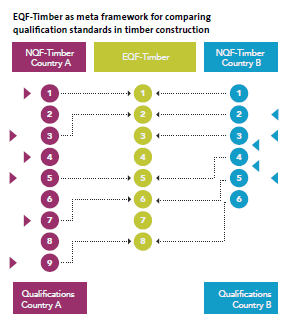
The EQF-Timber, as a qualifications framework tailored to the timber construction sector, is modelled in terms of content and structure on the general, cross-sectoral and cross-national European Qualifications Framework (EQF), which is designed to map individuals’ skills and competences across eight levels. Within this framework, qualifications increase as competences are acquired.
The adjacent diagram illustrates the relationship between the EQF and the European Qualifications Framework for Timber Construction in a simplified form. The left-hand column shows the breakdown of the EQF levels, whilst the middle column assigns the qualifications considered in the EQF-Timber to these levels. The third column names the qualifications, makes them comparable, and assigns examples of qualifications (vocational qualifications) in selected countries.
For further information on the development and current status of NQFs in the participating countries, see National Qualifications Frameworks (NQFs) | Europass
* The English term “EQF-Timber” is established across countries as the standard abbreviation for the European Qualifications Framework in timber construction.
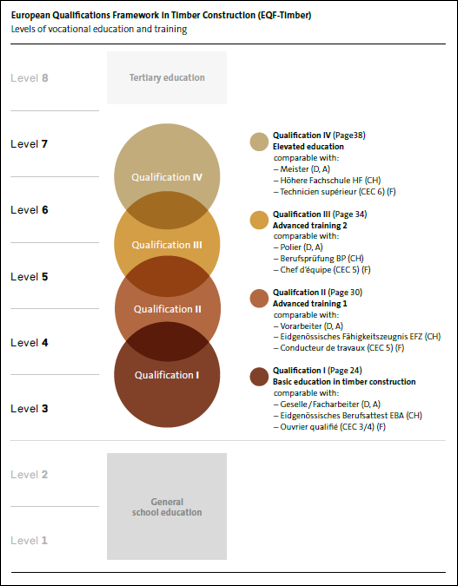
In line with its intended function, the EQF-Timber has the following particular features compared with the EQF: levels 1 and 2 remain outside the scope under consideration, as they describe the acquisition of competences within general schooling and are therefore not directly relevant to the acquisition of vocational competences. As the EQF-Timber is geared towards the competences of craft-based timber construction, its descriptions of competences end at level 7, which is generally equated with the aptitudes associated with the professional profile of the master craftsman in timber construction.
Considerations regarding the acquisition of academic competences – assigned to qualification levels 6, 7 and 8 in the general European Qualifications Framework – are not the subject of EQF-Timber.
The following organisations were involved in the development of the European Qualifications Framework in Timber Construction (EQF-Timber):